
📌 A Development Model of Instructional Competence in English for Careers for Vocational Teachers
本内容由泰语机器翻译,可能存在偏差。
活动日期 9/20/2026
📌 A Development Model of Instructional Competence in English for Careers for Vocational Teachers Improving vocational students' English proficiency begins with systematically empowering vocational
📌 A Development Model of Instructional Competence in English for Careers for Vocational Teachers
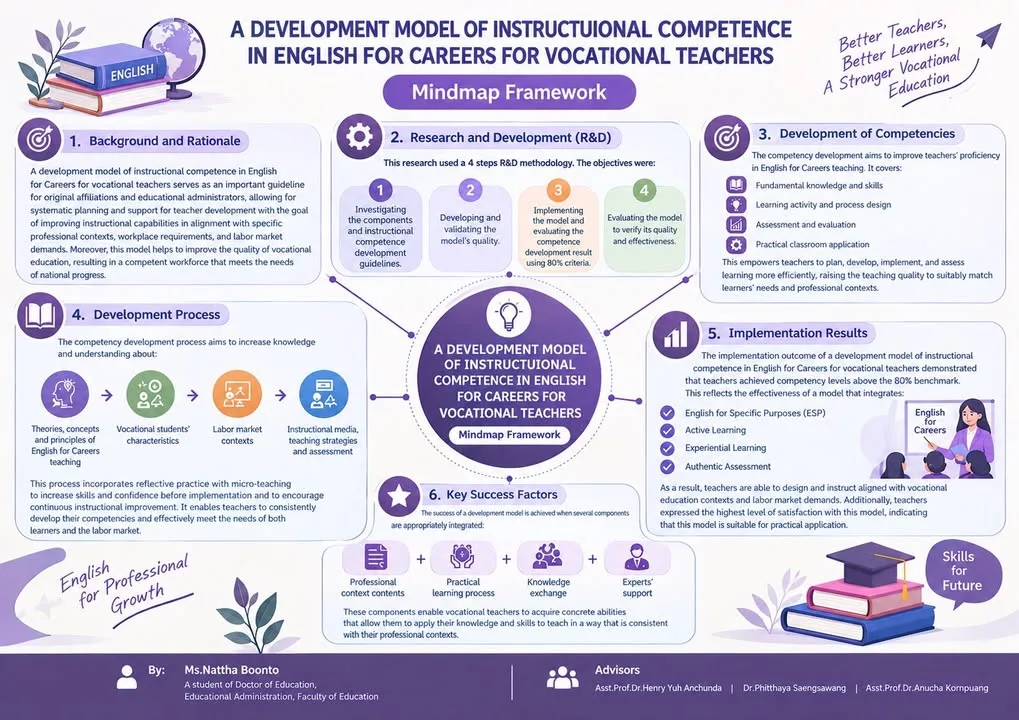
Improving vocational students' English proficiency begins with systematically empowering vocational teachers. Research by Ms. Nattha Boonto (Doctor of Education in Educational Administration, Faculty of Education, Naresuan University) presents a tailored model designed to meet workplace and labor market demands.
⚙️ 4-Step R&D Process
R1 - Study: Investigated components and guidelines for English for Careers teaching competence.
D1 - Design & Dev: Developed and validated the model's quality with experts.
R2 - Experiment: Implemented the model and evaluated teacher competence against an 80% benchmark.
D2 - Evaluate: Assessed post-implementation quality, effectiveness, and satisfaction.
🎯 Key Focus Areas
ESP Knowledge: Core concepts, theories, and labor market awareness.
Instructional Design: Active Learning and professional context-aligned activities.
Authentic Assessment: Practical measurement and evaluation methods.
Hands-on Application: Micro-teaching, reflective practice, and classroom implementation.
🏆 Core Outcomes
Exceeded Benchmark: Teachers achieved competency levels above the 80% criteria.
Highest Satisfaction: Participants rated the model's effectiveness and usability at the highest level.
Practical Impact: Enabled teachers to confidently design and deliver career-specific English instruction.
💡 成功因素:专业特定内容的实际整合、体验式学习、同伴交流和专家指导。
顾问:助理 Henry Yuh Anchunda教授| Dr. Phitthaya Saengsawang |助理 Anucha Kornpuang教授博士
# EducationalResearch # EducationalAdministration # EnglishForCareers # VocationalTeachers # TeacherDevelopment # ActiveLearning
🔥 这不仅仅是建立一个模型,而是回答: “你如何培养教师,你实际上将他们用于什么?”
研究A开发职业教师职业英语教学能力模型通过四步研发( R & D )过程开发模型: ( 1 )研究教学能力发展的要素和方法; ( 2 )开发模型并验证其质量; ( 3 )实施模型并使用80 %的参考标准评估其能力; ( 4 )评估其质量和有效性。
您🎯 如何培养教师? 这个过程不仅仅侧重于听讲座,而是从职业英语的知识和原则中发展而来。 →了解职业学习→者的特点,将教学与劳动力市场背景联系起来→,设计学习材料、教学策略和现成评估,反思性实践和微观教学,供教师在实际应用之前进行实验、教学、反思和改进。
教师实际使用🚀的是设计与职业相关的英语学习的能力,而不是教授传统英语,例如分析每个学科的学习者需要使用英语,设计模拟工作情况的活动。通过特定用途英语( ESP ) +主动学习+体验式学习+真实评估模型,选择与学习者匹配的材料和教学方法,并评估现实环境中的语言能力。
📈 因此,基于模型的实施结果,教师在发展后的表现比参考阈值高出80% ,教师对模型在最高层次上感到满意,因此工作的价值不在于“一个模型” ,而在于创造知识→实践的过程。 →胜任力→课堂应用已连接
💡 例如,酒店老师可能会从教授一般英语会话转变为教授酒店入住/处理房客投诉的情况,技术人员可能会设计“解释安全程序”或“阅读技术说明”活动,商务老师可能会使用“工作面试”、“客户沟通”或“商务演示” ,然后根据他们的工作量或虚拟情况评估学员,而不仅仅是衡量单词。这就是教育研究应该达到的目标--不仅仅是“积累知识” ,而是使这些知识能够改变教学,并最终建立学习者可以在工作世界中使用的能力。
研究→ 教师胜任力→课堂练习→学习者技能→员工准备情况
# EnglishForCareers # VocationalEducation # TeacherCompetency # ESP # ActiveLearning # AuthenticAssessment # TeacherDevelopment # EducationalInnovation # ResearchAndDevelopment # VocationalTeachers # FutureSkills
在Facebook上查看原始帖子