
How to use Generative AI in academic work with accurate, transparent and ethical references
This content was machine-translated from Thai and may contain inaccuracies.
Event date 11/6/2026
View original post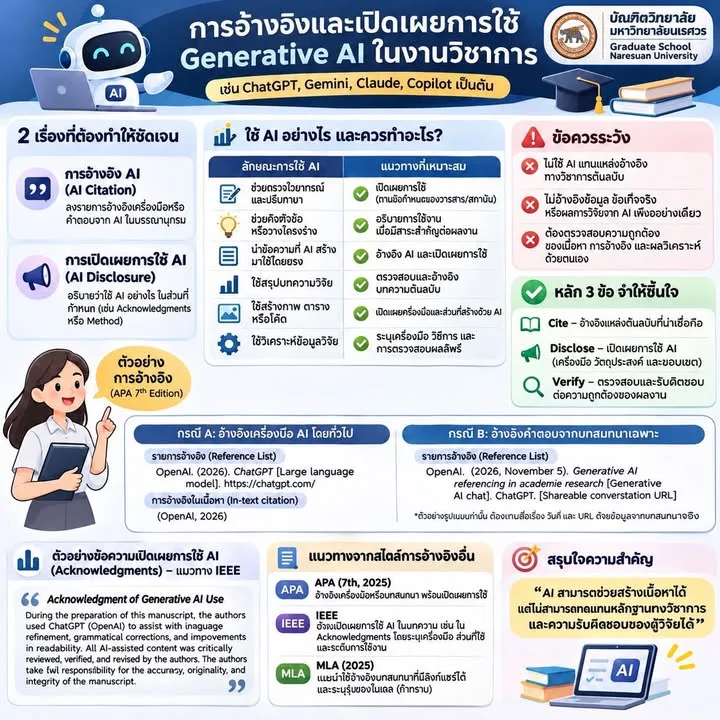
📚🤖 How to use Generative AI in academic work? Be accurate, transparent, and ethical in an era when generative AI such as ChatGPT, Gemini, Claude, and Copilot play a role in teaching and researching the use of AI…
- How to use Generative AI in academic work? Be referenced accurately, transparently, and ethically.
In an era when generative AI such as ChatGPT, Gemini, Claude, and Copilot have come into play in teaching and research, the proper use of AI is not just to know how to use tools, but to understand the principles of reference and academic responsibility.
The Naresuan University 🎓 Graduate School invites faculty and graduate students to understand two important issues.
- AI Citation – AI tool reference or AI-generated answerto a given format, such as APA, IEEE, or MLA.
- AI Disclosure – Disclosure of how AI is used in any stage of the study and research, such as language adaptation, outlining, content creation, or data analysis.
Easy to 💡 remember with 3 principles
- CITE-Referenced credible source of original data
- Disclose – Disclose the use of AI transparently
- Verify – Validate and take responsibility for the work itself.
- “AI is a tool for enhancing thinking, not a substitute for academic thinking and responsibility.”The quality of research depends not only on the use of cutting-edge technology, but also on the accuracy, reliability, transparency, and ethics of the investigator.
Generative AI reference 📌 guidelines and examples can be found in this infographic.
Note: AI citation and disclosure guidelines may vary according to the journal citation format and institutional requirements.
# Naresuan University Graduate School # GraduateSchoolNU # NaresuanUniversity # GenerativeAI # AIinResearch # AIResearchEthics # AcademicIntegrity#ResponsibleAI #GraduateResearch