
Drill down PM2.5 Phitsanulok is not just dust, it's the complexity of its origin and season.
This content was machine-translated from Thai and may contain inaccuracies.
Event date 9/24/2026
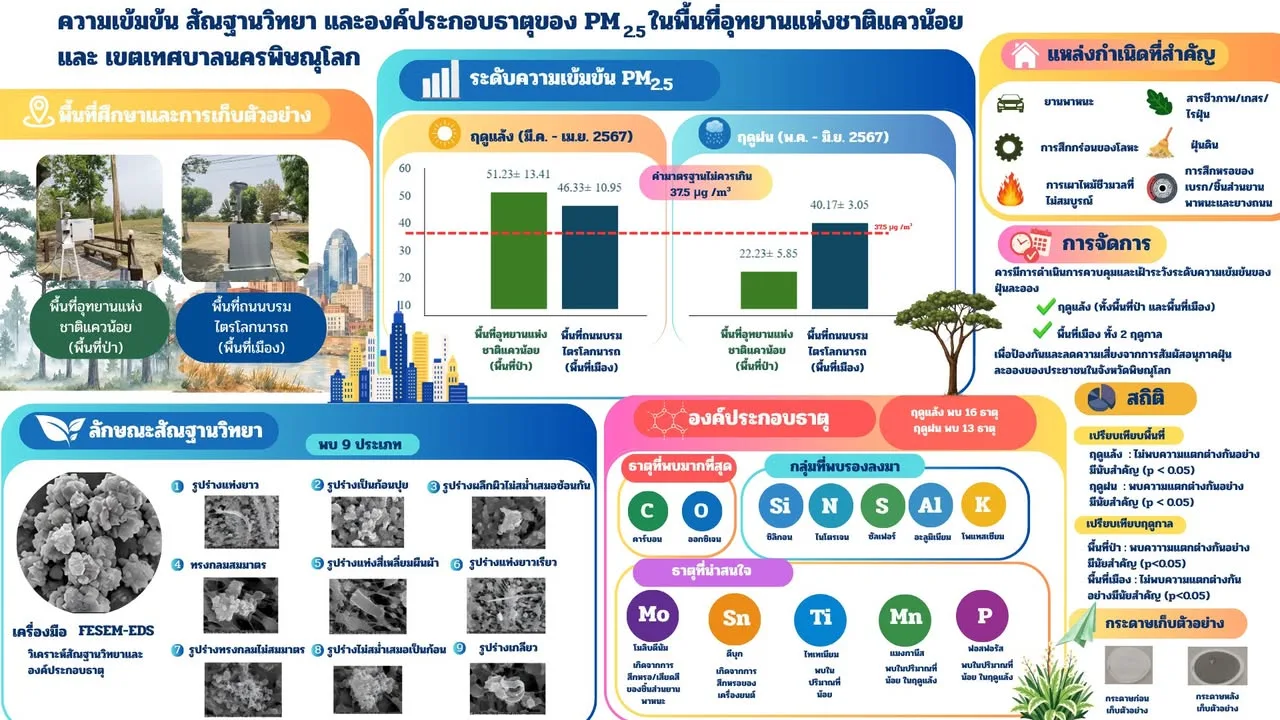
The graduate school of Naresuan University presented the results of a postgraduate study studying PM2.5 in Phitsanulok province by comparing the forest area (Kwai Noi National Park) with the urban area (Borom Trailok Road, Nakhon Phitsanulok Municipality) in both seasons.
The graduate school of Naresuan University presented the results of a postgraduate study that studied PM2.5 in Phitsanulok province by comparing the forest area (Kwai Noi National Park) with the urban area (Borom Trailok Road, Nakhon Phitsanulok Municipality) in both dry and rainy season. Through the analysis of the concentration, morphology and elemental composition of dust particles, PM2.5 was found to have 9 different forms and elemental composition linked to many sources, including biomass combustion, soil dust, metal erosion, and agricultural activities. The study indicated that PM2.5 managementthat effectively must consider both the amount of particle shape and elemental elements to identify the true origin. The owner of the work is Mr. Kanya Nattanajan, a graduate student. The mentor is Assoc. Prof. Dr. Kita Thanacharoenchanaphas, Department of Natural Resources and Environment, Faculty of Agriculture, Natural Resources and Environment, Naresuan University.
# research # PM dust # air pollution # morphology # elemental elements
View original post on Facebook