
First 99 days of driving Naresuan University graduate school
This content was machine-translated from Thai and may contain inaccuracies.
Event date 9/15/2026
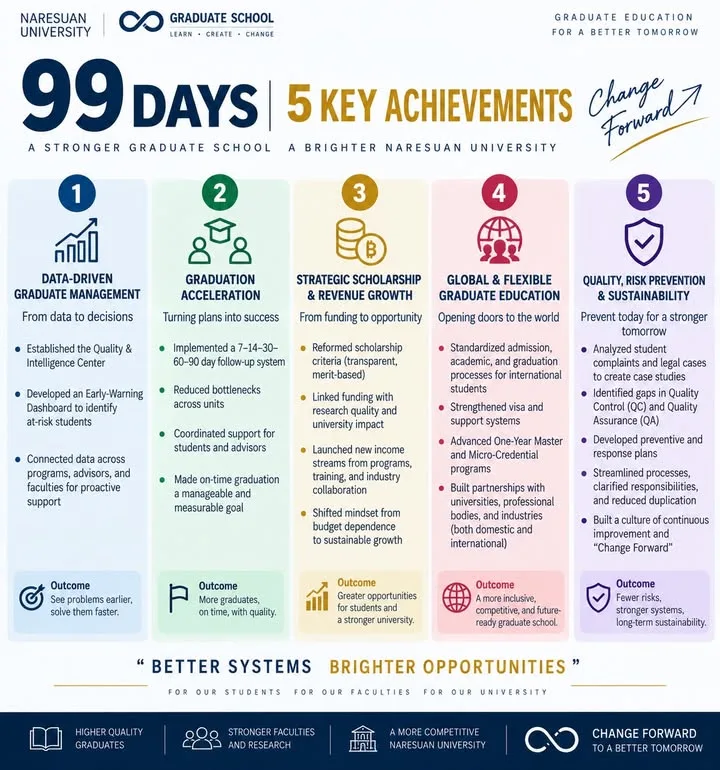
First 99 days of driving Naresuan University graduate school “From routine tasks to a system that sees problems, measures them, and moves them forward at the same time.” For the first 99 days of service, the Dean of the Graduate School targets
First 99 days of driving Naresuan University graduate school
“From routine tasks to a system that sees problems, measures them, and moves them forward at the same time.”
Throughout the first 99 days of his duties as Dean of the Graduate School, the goal is not to create more activities, but to make the graduate school the central mechanism of the university to enhance the quality of graduate education by adhering to the principles of “what does the university get and what do students get”. Therefore, every task must be answered in terms of quality, speed, transparency, and actual results.with significant contributions during the 99 days as follows:
1. Redirect the Graduate School-from the Administrative Unit to the Strategic Partner of all faculties.
Adjust the concept of work from taking matters and taking steps to becoming a central agency that helps the faculty solve problems, improve quality, and drive students to graduate by visiting the field to talk to the faculty, listen to problems from practitioners, teachers, and management to bring back real information to adapt the central system to better meet the needs of users.
2. Drive “Quality & Intelligence Center” —Turn data into management tools
Develop data centers and graduate quality analysis systems so that management can see the situation of students and their performance through real data, shifting from problem solving once it occurs to Data-Driven Management that can predict risks and make faster decisions.
3. Develop an Early-Warning Dashboard — Know Before Helping, Before Leaving the System Less
Pushing the system to track students who are at risk of delay or not graduating as planned.It aims to be able to identify vulnerable groups at an early stage and connect information to courses, mentors, and faculty so that assistance can be provided before the problem becomes severe, changing from “on call” to “seen first and managed first.”
4. Set up Graduation Acceleration Mechanism — Make finishing with time manageable.
Set up an accelerated system and track graduation using a 7-14-30-60-90 day follow-up period based on the urgency of the problem. Aim to reduce bottlenecks, coordinate relevant agencies, and let each student know that“Where you're stuck, who you're responsible for, and what are the next steps?”
5. Elevate the capital system — from “distributing capital” to “investing in potential”
Review the approach to grant management to have clear, transparent, and linked to academic quality by focusing on learners' potential, research, journal quality, and the results that the university will receive in order to make every baht of the scholarship to be an Investment in Graduate Excellence rather than budget allocation according to the original framework.
6. Go One-Year Master and Micro-Credential — Keep up with the world and learnersDrive flexible, short-duration, worker-responsive curricular concepts, including micro-credentials, that can accumulate and grow learning to expand the new learner base and create opportunities for university graduates to compete in the rapidly changing education market.
7. Launch a revenue offensive — Graduate schools must create both value and sustainability.
Putting in place ways to earn money through curriculum, developing academic service skills, collaborating with industry and professional networks, and expanding knowledge and innovation.by changing the perspective from relying solely on budget to the Growth & Sustainability Model
8. Create new networks and partnerships — connect universities with the outside world.
Advancing cooperation with universities, professional organizations, and industry, both domestically and internationally, by emphasizing that every cooperation must not end with signing, but must answer to what happens, what students get, what faculties get, and what universities get.
9. Enhance the International Graduate Experience — Foreigners must come in and walk throughout the system.Review the process for international students, from application, admission, examination, dissertation, graduation, as well as visa coordination, to aim to create a single standardized system, reduce duplication, and make the university truly ready for the increase of international students.
10. Field trip to all faculties — “Listen to the real thing before solving the real thing”
Use road shows and direct talks as an important tool to listen to the pain points of each faculty because the problems of graduates cannot be looked at centrally only on one side.The information received is therefore used to adapt the protocols, services, tracking systems and policy-making to the actual context.
11. Turn feedback into a problem-proof QC-QA system
Begin to put in place guidelines for complaints, disputes, and cases in which students litigate with the university into case studies and gap analyses to identify process loopholes in both Quality Control (QC) and Quality Assurance (QA) and use the lessons to create a Preventive & Response Plan so that the university will not only“Resolve when the incident occurs” but can “prevent before the incident occurs.”
12. Reduce duplication and create clear hosts — Right Job, Right Owner, Right Time
Adjust the internal management approach to make each department see their roles and responsibilities more clearly, reduce repetitive tasks, reduce loop submissions, and emphasize that every important mission requires an Owner + Timeline + Output + KPI to be able to track who did what, when, and at what level of achievement.
13. Create a “Change Forward” Culture — Change to move forward, not change because the original is bad.Create a working atmosphere that provides value to the original experience, but adjusts processes that do not meet the future. Provide a space for personnel to reflect opinions and make management and staff work on the same goals: faster, easier, clearer and more beneficial to students.
14. The first 99 days are therefore not the destination, but the “system deployment” for the next 4 years.
The most important thing in 99 days is not the number of projects or the number of meetings, but to start building data structures, tracking mechanisms and teams.To keep the change going even without having to wait for the Dean's orders on everything, the next goal is to make the initial system measurable, scalable, and organizational culture.
99 days: from “administration” TO “system building”
99 days ago We didn't try to get everything done, but we started doing the important things in the right direction, switching from waiting for problems to seeing problems before switching from existing information to decision-making information, switching from fragmented work to working with all faculties, and switching from questions of:“What do college graduates do?” is a question that I apply to every job: “What do universities get and what do students get?”
Because in the end, the success of the graduate school is not measured by how much the graduate school works, but by how much we can make students graduate with quality, easier working groups, and stronger universities.
— This is the first 99 days and is just the beginning of Change Forward.
View original post on Facebook