
📌 A Development Model of Instructional Competence in English for Careers for Vocational Teachers
This content was machine-translated from Thai and may contain inaccuracies.
Event date 9/20/2026
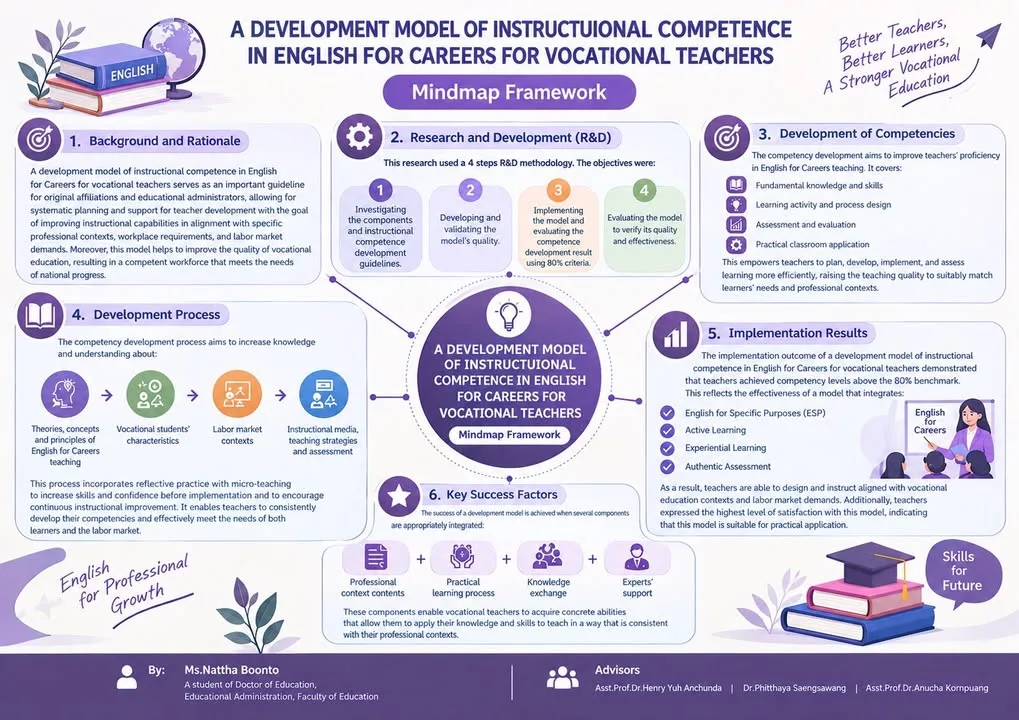
📌 A Development Model of Instructional Competence in English for Careers for Vocational Teachers Improving vocational students' English proficiency begins with systematically empowering vocational
📌 A Development Model of Instructional Competence in English for Careers for Vocational Teachers
Improving vocational students' English proficiency begins with systematically empowering vocational teachers. Research by Ms. Nattha Boonto (Doctor of Education in Educational Administration, Faculty of Education, Naresuan University) presents a tailored model designed to meet workplace and labor market demands.
⚙️ 4-Step R&D Process
R1 - Study: Investigated components and guidelines for English for Careers teaching competence.
D1 - Design & Dev: Developed and validated the model's quality with experts.
R2 - Experiment: Implemented the model and evaluated teacher competence against an 80% benchmark.
D2 - Evaluate: Assessed post-implementation quality, effectiveness, and satisfaction.
🎯 Key Focus Areas
ESP Knowledge: Core concepts, theories, and labor market awareness.
Instructional Design: Active Learning and professional context-aligned activities.
Authentic Assessment: Practical measurement and evaluation methods.
Hands-on Application: Micro-teaching, reflective practice, and classroom implementation.
🏆 Core Outcomes
Exceeded Benchmark: Teachers achieved competency levels above the 80% criteria.
Highest Satisfaction: Participants rated the model's effectiveness and usability at the highest level.
Practical Impact: Enabled teachers to confidently design and deliver career-specific English instruction.
💡 Success Factors: Practical integration of profession-specific content, Experiential Learning, peer exchange, and expert mentorship.
Advisors: Asst. Prof. Dr. Henry Yuh Anchunda | Dr. Phitthaya Saengsawang | Asst. Prof. Dr. Anucha Kornpuang
# EducationalResearch # EducationalAdministration # EnglishForCareers # VocationalTeachers # TeacherDevelopment # ActiveLearning
🔥 It's not just about building a model, it's about answering, “How do you develop teachers and what do you actually use them for?”
Research A DevelopmentThe Model of Instructional Competence in English for Careers for Vocational Teachers develops the model through a four-step research & development (R&D) process: (1) studying the elements and approaches of teaching competency development; (2) developing the model and verifying its quality; (3) implementing the model and evaluating its competency using 80% reference criteria; and (4) evaluating its quality and effectiveness.
🎯 How do you develop teachers? The process does not focus solely on listening to lectures, but develops from the knowledge and principles of English for Careers. →Understanding the characteristics → of vocational learners, connecting teaching with the labor market → context, designing learning materials, teaching strategies, and ready-to-use assessments, Reflective Practice, and Micro-teaching for teachers to experiment, teach, reflect, and improve before they actually apply.
🚀 What teachers actually use is the ability to design career-related English learning, not teach conventional English, such as analyzing what learners in each discipline need to use English for, designing activities that simulate work situations.Select materials and teaching methods to match learners and evaluate language proficiency in real-world situations by the integrated English for Specific Purposes (ESP) + Active Learning + Experiential Learning + Authentic Assessment model.
As a 📈 result, based on the model implementation results, the teacher's performance after development was 80% higher than the reference threshold, and the teacher was satisfied with the model at the highest level. Therefore, the value of the work was not in having “one model” but in creating the processes that make Knowledge → Practice. →Competency → Classroom Application Connected
💡 For example, to illustrate, a hotel teacher might change from teaching general English conversation to a Hotel Check-in/Handling Guest Complaints situation, a technician might design an Explaining Safety Procedures or Reading Technical Instructions activity, and a business teacher might use Job Interview, Customer Communication, or Business Presentation, and then evaluate learners based on their workload or virtual situation instead of just measuring words.This is where educational research should get to — not just “building knowledge”, but enabling that knowledge to transform teaching and ultimately building competencies that learners can use in the working world.
Research → Teacher Competency → Classroom Practice → Learner Skills → Workforce Readiness
# EnglishForCareers # VocationalEducation # TeacherCompetency # ESP # ActiveLearning # AuthenticAssessment # TeacherDevelopment # EducationalInnovation # ResearchAndDevelopment # VocationalTeachers # FutureSkills
View original post on Facebook